Seven Common Mistakes When Replacing Slipped or Broken Slates
A slipped slate looks like a ten-minute job, but wrong nails, mismatched sizes and torn underlay turn a...


Three materials, three very different roofs. Walk down any street of Victorian terraces and you can usually spot all three within fifty metres: the flat blue-grey of natural slate, the paler and more uniform grey of fibre cement, and the warm red or orange of clay. From the pavement they look like variations on a theme. Up close, and on a quotation, they behave nothing alike.
The names get used loosely, so it's worth being precise before you compare anything.
If what you want is the look of slate, only two of these are in the running. Clay is a different aesthetic entirely, and no amount of clever marketing changes that.
In broad terms, natural slate sits at the top, clay plain tiles sit somewhere in the middle, and fibre cement sits at the bottom. A fibre cement roof frequently comes in at roughly half the installed cost of a good natural slate roof, with clay falling between the two depending on whether you choose plain or interlocking tiles.
But here's the thing most homeowners miss: the tiles themselves are often only a third or so of the bill. The rest is everything underneath and around them.
This is why upgrading from a basic membrane to a proper one, or from cheap nails to stainless steel, adds a surprisingly small amount to the overall figure. Those are the wrong places to save money. Get a written specification with the quote, not just a total.
Natural slate is the long-distance runner. Good Welsh slate routinely lasts well over a century, and there are plenty of roofs still going at 150 years. Be careful with cheap imported slate, though — quality varies enormously between quarries and batches, and some of it will be tired at forty years. Whatever you buy, the fixings usually fail before the slate does.
Fibre cement is typically expected to give somewhere between thirty and fifty years. It's brittle at the edges when handled or walked on, and it can chip. Newly laid fibre cement sometimes shows a white bloom for a few months, which is harmless and weathers away.
Good clay plain tiles will comfortably reach sixty to a hundred years, and some last far longer. Older, more porous tiles can delaminate, and the mortar bedding and pointing on ridge tiles usually needs renewing every twenty to thirty years regardless of the tile itself.
Divide the total cost by the expected life and the gap narrows considerably. That's the calculation worth doing if you plan to stay put.
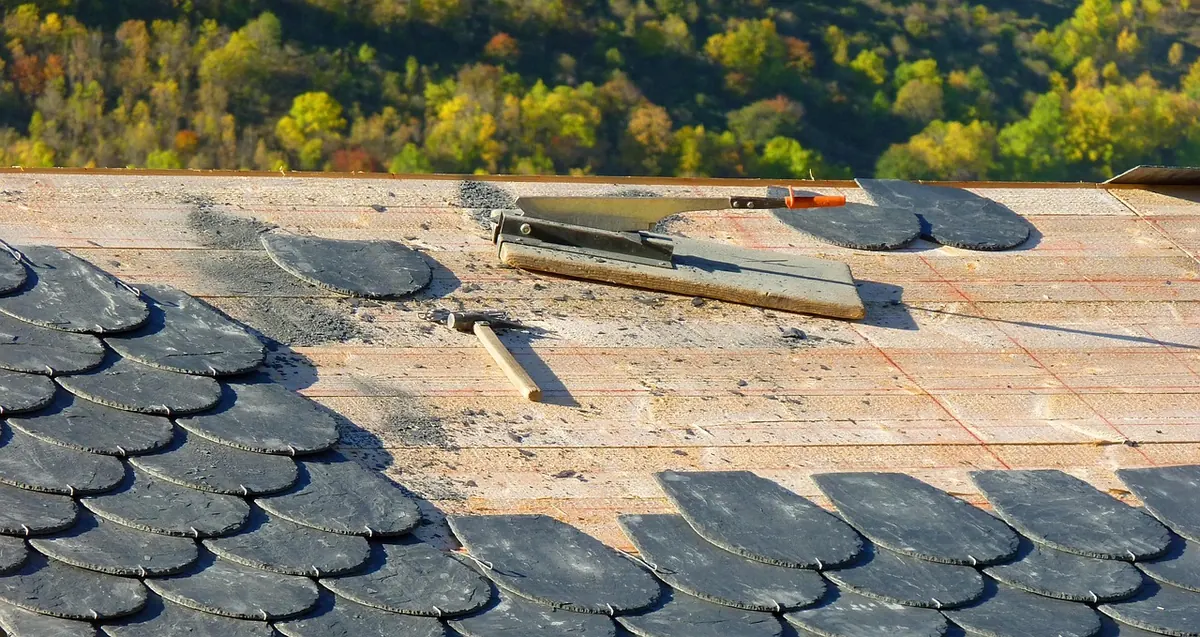
Natural slate is graded into sizes, and a traditional roof uses diminishing courses — bigger slates at the eaves, smaller ones towards the ridge. Thickness varies slightly, surfaces are riven rather than smooth, and colour shifts from tile to tile and across the roof as it weathers. That irregularity is exactly what makes it look right on an older building.
Fibre cement is the opposite: uniform in thickness, sharper at the edges, and consistent in colour. The better products have chamfered edges, a riven texture and a narrow range of tones, and mixing two or three sizes helps. On a large roof viewed from the road, that's often convincing enough. Standing directly beneath it, the regularity gives it away.
If your property is listed or sits in a conservation area, check with your local authority before ordering anything. Many councils expect a like-for-like match with the original covering, and slate-effect cement may not be accepted. The same applies if you're extending an existing clay roof: matching the original is usually the sensible route.
Clay plain tiles are the heaviest of the three, natural slate is heavy, and fibre cement is noticeably lighter than both. That matters if the roof structure has been carrying the same covering for a hundred years and has sagged, or if you're re-roofing a timber-framed building. Have a structural engineer or your roofer check before you go heavier.
Pitch matters too. Plain clay tiles generally want a steep roof, commonly 35 degrees or more. Natural slate and fibre cement slate will work at lower pitches provided the lap is increased and the manufacturer's guidance is followed. Interlocking clay tiles can go lower still. Your roofer should be checking the pitch and exposure of your roof against the manufacturer's tables before quoting, not after.
Natural slate if the building is period, the roof is on show, you're staying long term, or a conservation officer is watching. It costs most up front and least per decade.
Fibre cement if the budget is fixed, the roof is large, or the surface won't be examined closely — a steep roof on a modern house, for example. It's a perfectly serviceable covering, just don't expect anyone to mistake it for Welsh slate at close range.
Clay if the house was tiled originally, or if the character of the street depends on that warm red-orange colour. It's a different question to the slate one, not a compromise on it.
Ask every roofer for the same written details, and compare like for like:
Then take your time. A roof is a ten-year decision at best and a hundred-year one at worst, and the difference between the quotes is usually in the details rather than the tiles.
Photo: Cao135 / Pixabay
A slipped slate looks like a ten-minute job, but wrong nails, mismatched sizes and torn underlay turn a...
A month-by-month routine for inspecting a slate roof from the ground, spotting slipped slates and blocked...
Twelve seasonal jobs — from clearing gutters and checking flashings to replacing slipped slates and...