Seven Common Mistakes When Replacing Slipped or Broken Slates
A slipped slate looks like a ten-minute job, but wrong nails, mismatched sizes and torn underlay turn a...


Most Victorian slate roofs are still doing their job a century or more after they were laid. That is worth remembering before anyone reaches for the skip: Welsh slate quarried in the 1890s has frequently outlasted the nails and battens holding it up. The real question is not whether the roof looks tired, but which of its three main elements — slate, battens and fixings — has actually reached the end of its useful life. Get that judgement right and you can spend a fraction of the cost of a full re-slate.
Before anyone goes up a ladder, spend half an hour in the attic with a torch. It is dry, safe and far more informative than a view from the garden path. On a wet day you can often trace exactly where water is getting in.
Not every glint of daylight is a leak. At the eaves you may simply be seeing past the underlay, or through the gap that ventilation requires. Judge the roof as a whole rather than reacting to one crack of light.
A decent pair of binoculars from the ground will tell you a lot before anyone sets foot on the slates. Look for slipped and missing slates, especially at the eaves and along verges where wind gets underneath. Look for the patchwork of odd slates in different colours and thicknesses that betray decades of piecemeal repair. Check the valleys for moss and debris, the chimney stack for failed soakers and stepped flashings, and the ridging for cracked or missing mortar.
Up close, sound each slate lightly with your knuckles or the handle of a hammer. A clear ring means the slate is solid; a dull thud or a hollow note usually means it has begun to delaminate. Run a thumb along the edges — if thin layers are lifting, that slate has had it. Slate is brittle and unforgiving underfoot, so a proper roof ladder, crawl boards and edge protection are not optional, and anything more than a look from the ground is best left to someone who works at height every week.
Victorian roofs were usually laid with the best slate the budget allowed, often in diminishing courses, with the largest slates at the eaves and the smallest near the ridge. That pattern is part of the roof's character and worth preserving. Individual slates fall into three rough groups:
Resist the temptation to pressure-wash a slate roof. It strips the weathered surface, opens the laps and drives water where it should not go. A soft brush and a bit of patience with moss is gentler and cheaper in the long run.
The slate is the visible half of the story. The half that decides whether your roof lives another thirty years is hidden behind it. Victorian battens were usually softwood, and the nails were iron or early galvanised wire. Both have a finite life, and once they go, the slates above them are simply resting in place.
Test the fixings rather than guessing. In the loft, grip a slipped slate's nail with pliers and pull gently. If it comes out easily, or snaps, the whole nail population is suspect. If the batten crumbles where a nail passes through it, no amount of new slating will hold. New fixings should be copper, silicon bronze or stainless steel, sized to suit the batten.
Many Victorian roofs had no underlay at all, or relied on torching and lime mortar. If the roof is being stripped anyway, a breathable membrane is worth discussing, but it changes how the roof dries, and on solid or torched historic roofs it can trap moisture rather than release it. Take advice on ventilation at the same time; new insulation pushed tight to the eaves without an air path is a reliable way to create condensation problems.
Scaffolding and access usually account for a large share of any roofing bill, so anything with a limited life should be dealt with while you are paying for it:
There is no single number that tells you to re-slate, but the balance tips fairly clearly once you look at the right things. Scattered individual failures on a roof with sound battens can be managed with repairs for years. Failures that arrive in patches, winter after winter, with rust dust in the loft and soft battens underfoot, are a different proposition.
A full strip does not mean throwing everything away. Salvage every sound slate, sort it by size and thickness, and reuse it where the pattern allows. Anything left over has value to someone restoring a similar roof.
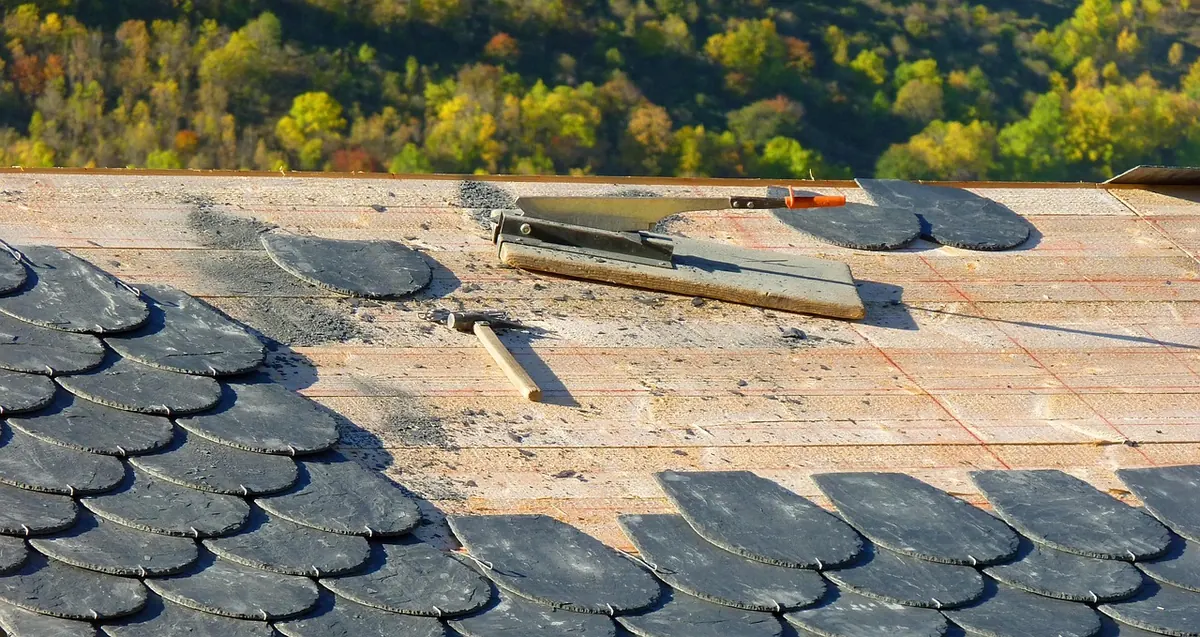
Photo: scholty1970 / Pixabay
A slipped slate looks like a ten-minute job, but wrong nails, mismatched sizes and torn underlay turn a...
A month-by-month routine for inspecting a slate roof from the ground, spotting slipped slates and blocked...
Twelve seasonal jobs — from clearing gutters and checking flashings to replacing slipped slates and...